
Simple embroidery designs are one of the easiest ways to discover how much creativity can fit inside a needle, a piece of thread and a small area of fabric. A flower can begin with a few straight stitches. A leaf can grow from a simple outline. A row of stars, initials or tiny geometric shapes can turn an ordinary shirt, tote bag or fabric scrap into something completely personal.
That simplicity is part of embroidery's magic. You do not need to begin with an elaborate pattern or dozens of complicated stitches. A handful of basic techniques can produce an enormous variety of designs once you begin experimenting with shape, spacing, color and texture.
For beginners, embroidery can also be a wonderfully approachable introduction to hand sewing. The process is slow enough to understand, portable enough to take almost anywhere and flexible enough to make each project your own.
At Moving Thread LA, hand stitching is explored as both a practical and decorative skill, helping makers understand how simple stitches can be used for embellishment, mending and creative personalization.
Why Are Simple Embroidery Designs So Good for Beginners?
Simple embroidery designs are ideal for beginners because they let you practice individual stitches without needing to complete a large or technically complicated project. You can concentrate on learning how the needle moves through the fabric and how thread creates lines, shapes and texture.
A small design also gives you room to experiment.
If one flower looks slightly different from another, that does not necessarily ruin the piece. It can make the embroidery feel handmade. If a line bends unexpectedly, it may become part of the design rather than something that needs to be hidden.
This makes embroidery particularly inviting for people who feel nervous about sewing. There is usually time to stop, look at what you are doing and decide where the next stitch should go.

What Do You Need to Start Hand Embroidery?
You can begin hand embroidery with only a few basic tools: fabric, embroidery thread, a suitable hand-sewing needle, scissors and an embroidery hoop if the project benefits from keeping the fabric taut.
The materials do not need to be complicated.
- Fabric: A stable woven fabric can make it easier to see and control your stitches when you are learning.
- Embroidery floss or thread: Different colors and thread thicknesses can completely change the appearance of the same design.
- Needle: Choose a needle that works comfortably with your fabric and the thickness of your thread.
- Embroidery hoop: A hoop can hold the fabric steady while you stitch.
- Small scissors: Useful for trimming thread cleanly.
- Design marker or transfer method: A removable fabric-marking tool can help you sketch or transfer a simple pattern before stitching.
Once those basics are ready, the most important material is simply an idea.
Which Embroidery Stitches Should a Beginner Learn First?
Beginners can create a surprising number of designs with only a few fundamental stitches. You do not need to learn every embroidery technique before beginning your first project.
| Stitch | What It Creates | Simple Design Ideas |
|---|---|---|
| Running stitch | A broken or dashed line | Borders, paths, waves and geometric patterns |
| Back stitch | A continuous outlined line | Names, stems, drawings and lettering |
| Straight stitch | Individual straight lines | Stars, petals, rays and tiny details |
| Chain stitch | Connected looped stitches | Outlines, stems and decorative borders |
| Blanket stitch | Decorative edge stitching | Edges, patches and visible mending |
| Satin-style filling | Closely packed areas of thread | Small petals, leaves and solid shapes |
Even one stitch can become visually interesting when you change its length, direction, spacing or color. Embroidery becomes less about memorizing techniques and more about discovering what each stitch can do.
Simple Flower Embroidery Designs
Flowers are among the easiest subjects to simplify into embroidery because they are naturally made from repeated shapes. A stem can be a stitched line. Leaves can be two or three angled stitches. Petals can radiate from a central point.
You might start with a tiny daisy made from straight stitches surrounding a contrasting center. Then add a stem and two leaves. Once that feels comfortable, repeat the same flower at different heights to create a small garden.
Try varying the design rather than making every flower identical:
- Use long thin petals for one flower and short rounded shapes for another.
- Combine two shades of the same color.
- Make some flowers tiny and others oversized.
- Add curved stems instead of perfectly straight ones.
- Place flowers in a border, cluster or loose scattered pattern.
- Embroider a single small flower onto a pocket or cuff.
The goal does not have to be botanical accuracy. A stitched flower can be imagined rather than copied from nature.
Easy Leaf and Botanical Embroidery Ideas
Leaves are another beginner-friendly subject because a simple branch can be constructed from just one central line with short stitches extending from either side.
Try embroidering a curved stem first. Add pairs of small leaves as you move upward. That single motif can become a sprig, wreath, border or part of a larger floral design.
Botanical embroidery also gives you plenty of freedom with color. Leaves do not have to be green. Try rust, pink, blue, gold or several shades together. Changing the color immediately turns a realistic plant into something more graphic and imaginative.
Simple Geometric Embroidery Designs
Geometric embroidery is a good choice if flowers are not your style. Straight lines, circles, triangles, grids and repeated marks can create bold designs using very basic stitches.
A row of tiny crosses can become a border. Repeated triangles can form a mountain-like pattern. Several stitched circles can overlap into an abstract composition. Straight lines radiating from a central point can create a sunburst.
Geometric designs are especially useful for practicing consistency because you begin noticing spacing, alignment and repetition.
But perfect symmetry is not required. Slight irregularities can give the finished work character.

Can You Embroider Words and Initials?
Yes. Words, initials and short phrases can make some of the most personal simple embroidery designs. A basic back stitch works well for following the outline of handwritten or printed lettering.
You could embroider:
- Your initials on a tote bag
- A child's name on a fabric item
- A short word on a pocket
- A meaningful date
- A small monogram
- A handwritten phrase transferred onto fabric
Lettering does not need to be elaborate. In fact, a simple handwritten style can look especially charming because the stitches preserve the movement of the original writing.
Turn Everyday Objects Into Embroidery Ideas
Almost any recognizable object can become an embroidery motif once you reduce it to its most important lines.
A coffee cup might need only an outline and handle. A tiny house can be made from a square, roof and door. A moon can be a simple curved shape. A cat might be reduced to pointed ears, whiskers and a curved body.
Look around your home or neighborhood and ask what could be simplified into thread.
- Stars and moons
- Fruit
- Hearts
- Clouds and rainbows
- Faces
- Pets
- Buildings
- Food
- Small landscapes
- Objects connected to a favorite hobby
This is where embroidery can start feeling much more personal than simply following a pattern.
How Do You Create Your Own Simple Embroidery Design?
To create your own embroidery design, begin with a simple drawing and remove any details that are not necessary. Think in terms of lines and shapes rather than trying to reproduce every feature of the original subject.
A useful process is:
- Choose one simple subject.
- Sketch it on paper using as few lines as possible.
- Decide which parts will be outlines and which areas, if any, should be filled.
- Choose two to five thread colors.
- Transfer or lightly draw the design onto your fabric using an appropriate removable fabric-marking method.
- Start with the larger outlines.
- Add small details once the main shape is established.
- Stop before the design becomes unnecessarily complicated.
That final step matters. Simple designs often work because they leave room around the stitches.
Try Embroidery on Clothes You Already Own
Embroidery does not need to stay inside a hoop. One of the most satisfying uses for hand stitching is adding a small design to clothing or accessories you already own.
A tiny motif can completely change the feeling of an ordinary garment.
- Add a flower to a shirt pocket.
- Stitch stars along a denim cuff.
- Add initials to the corner of a handkerchief.
- Create a decorative border around a patch.
- Add a small design to a tote bag.
- Use visible stitches around a repair to make the repair part of the design.
- Decorate an older garment with scattered motifs.
Before embroidering a favorite garment, practice the design on scrap fabric first. Different garment fabrics behave differently, so it helps to understand how your chosen material responds to the needle and thread.
Embroidery and Visible Mending Can Work Together
Embroidery can turn a practical repair into a visible design choice. Instead of trying to make every mend disappear, decorative stitching can draw attention to the repaired area and give the garment a new story.
A patch can be surrounded with blanket stitch. A small worn area can become the center of a stitched flower. Several lines of running stitch can reinforce fabric while creating a repeated pattern.
This connection between decoration and function is also part of the hand-sewing approach explored at Moving Thread LA. The Hand Sewing, Mending and Embellishments workshop has included running stitch, back stitch, chain stitch and blanket stitch alongside mending, hemming, embellishment and embroidery techniques. Check the workshop page for its current scheduling or availability before planning a visit.
What Can You Embroider as a First Project?
A good first embroidery project should be small enough to finish without becoming repetitive. Completing something simple often teaches more than beginning an ambitious piece that remains unfinished.
Try one of these ideas:
- A three-flower mini garden
- A small leafy branch
- Your initial surrounded by tiny stars
- A row of geometric shapes
- A simple sun and moon design
- A tiny fruit motif
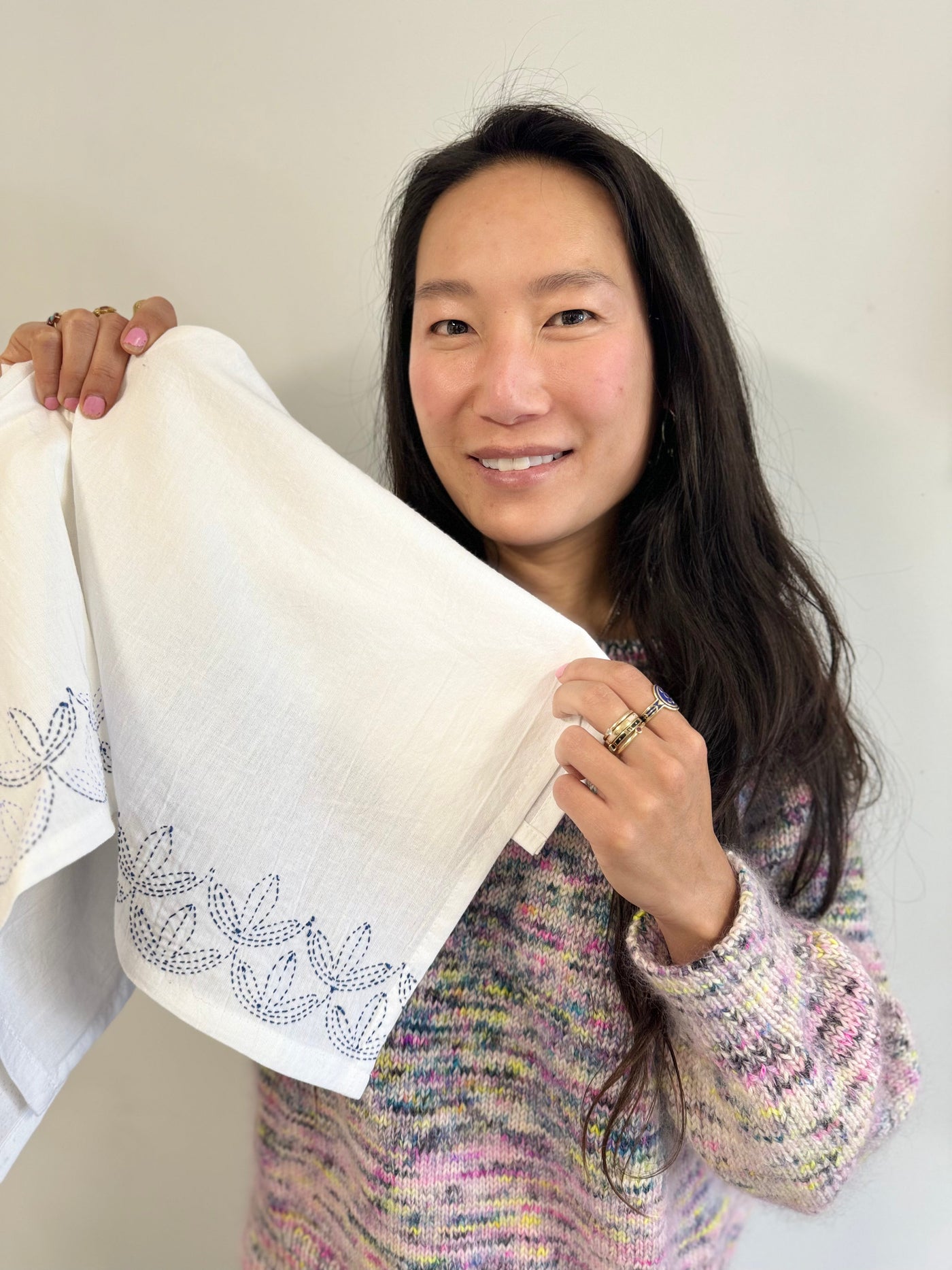
- A decorative border on a fabric napkin
- A small embroidered patch
- A line drawing of a favorite object
- A few scattered flowers on a tote bag
Once you finish one small design, repeat it in another color or change one element. That is an easy way to build confidence while developing your own visual style.

How Do You Make Simple Embroidery Designs Look More Interesting?
You can make a simple embroidery design more interesting without making it technically difficult. Change the scale, thread thickness, spacing or color instead of immediately adding more complicated stitches.
Imagine five identical flowers embroidered in a straight row. Now make one flower twice as large. Or use five different shades of the same color. Place them diagonally instead of horizontally. Mix dense stitching with open space.
The individual stitch has not become harder, but the composition has become more expressive.
Some useful experiments include:
- Using one design in several different sizes
- Working with a limited color palette
- Combining thick and fine thread
- Leaving deliberate areas of empty fabric
- Repeating one motif in an unexpected arrangement
- Using contrasting thread on dark or brightly colored fabric
- Combining outlines with small filled areas
Simple does not have to mean plain. It often means being deliberate about the details you choose to include.
Why Hand Embroidery Feels Different From Machine Sewing
Hand embroidery moves at a very different rhythm from machine sewing. Each stitch is placed individually, giving you time to watch the design grow a few millimeters at a time.
That slower pace is part of the attraction.
You can stitch while thinking, talking or listening to something. The project can be paused and returned to later. There is no need for every mark to be mechanically identical.
Hand embroidery also teaches you to notice thread differently. A line is no longer something drawn with ink. It has thickness, texture and direction. Light catches the thread. Several stitches layered together create depth.
It is a remarkably simple process that can become as detailed as you want it to be.
Do Simple Embroidery Designs Need to Be Perfect?
No. Handmade embroidery does not need perfect repetition to look beautiful. Slight differences between stitches can be part of what makes the work feel personal.
Learning does involve improving control. You will gradually become better at maintaining stitch length, following curves and judging spacing. But technical consistency should support the design rather than remove every trace of the person who made it.
If your first leaf is slightly crooked, keep going.
If one flower is larger than planned, perhaps add another large flower somewhere else.
Embroidery gives you room to respond creatively instead of treating every unexpected stitch as a failure.
Ready to Try Simple Embroidery Designs?
Simple embroidery designs prove that you do not need complicated tools or elaborate patterns to make something expressive. A few stitches can become flowers, leaves, initials, stars, geometric forms or tiny illustrations that make fabric feel uniquely yours.
Start small. Choose one motif. Learn a stitch that can create it. Make the first version without worrying about perfection, then make another and see what you want to change.
If hand stitching makes you curious about sewing, mending and fabric embellishment more broadly, explore Moving Thread LA's current classes and workshops to see what is being offered at the Los Angeles studio.
Sometimes creativity begins with nothing more complicated than pulling a piece of thread through fabric and wondering where the next stitch should go.
Frequently Asked Questions About Simple Embroidery Designs
What is the easiest embroidery design for a beginner?
A small flower, leafy branch, heart, star or simple line drawing can be a good first embroidery design. Choose a motif that can be created mainly with straight, running or back stitches so you can concentrate on controlling the needle and thread.
Which embroidery stitches should beginners learn?
Running stitch, back stitch and straight stitch are useful starting points. Chain stitch and blanket stitch can then add more decorative options once you are comfortable controlling basic hand stitches.
Can I embroider directly onto clothes?
Yes, many garments can be embellished with hand embroidery, but the fabric and construction of the garment affect how easy it is to stitch. Practice your design on scrap fabric first and make sure your needle, thread and technique suit the garment material.
How do I make my own simple embroidery pattern?
Start with a basic drawing, simplify it into essential outlines and shapes, choose a small color palette, and transfer the design to fabric using an appropriate removable marking method. Begin with the main outlines before adding smaller decorative details.
Can embroidery be used for mending clothes?
Yes. Decorative hand stitches can be combined with suitable repair techniques to make mending part of the garment's design. Visible stitching can highlight a patch or repaired area instead of trying to hide it completely.